If your baby seems to wake up the second you’ve finally sat down with a cup of tea, you’re definitely not alone (cold tea club). One of the most common questions parents ask is, “How long should a baby nap?” Understanding baby nap lengths by age can make a huge difference when you’re trying to work out whether your baby’s sleep is developing normally.
The truth is that baby naps by age can look very different, especially during the first year. Some babies take short 30-minute cat naps, while others seem happy to sleep for hours. It can leave you wondering whether your baby’s nap times are completely normal or whether something needs to change.
In this guide, we’ll look at normal baby nap lengths by age, why some babies wake after just one sleep cycle, and a few simple newborn nap tips that may help encourage longer, more settled naps, from one mum to another.
This post contains affiliate links. This means I may earn a small commission if you choose to make a purchase through my links, at no extra cost to you. I only recommend products I genuinely believe can help make life a little easier for parents.
Baby Nap Lengths By Age
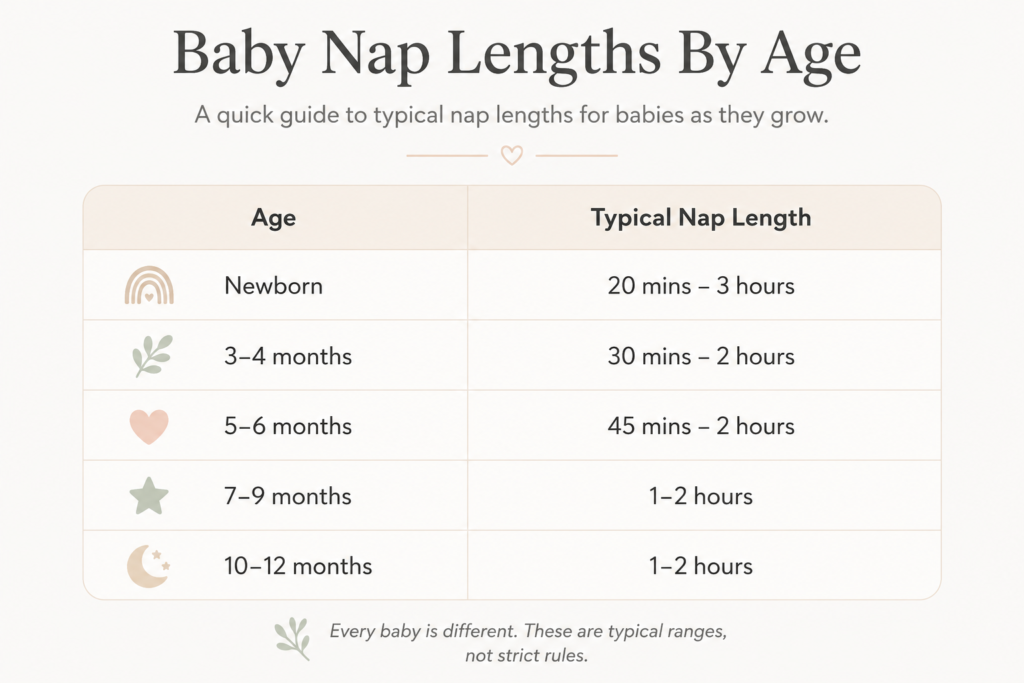
While every baby is different, understanding typical baby nap lengths by age can help set realistic expectations. Some babies naturally take short naps, while others sleep for much longer stretches. These ranges are a guide rather than strict rules and can vary depending on your baby’s temperament, development, and overall sleep needs.
Newborn Nap Lengths
Newborn naps can be all over the place. Some last 20 minutes, while others stretch to a few hours. In the early weeks, this is usually completely normal.
3–4 Month Nap Lengths
Many babies start developing more predictable sleep patterns at this age, but 30–45 minute naps are still very common.
5–6 Month Nap Lengths
Some babies begin linking sleep cycles more consistently around 5–6 months, which can lead to longer naps.
7–12 Month Nap Lengths
As babies get older, naps often become more predictable, with many settling into two daytime naps.
Why Does My Baby Wake After One Sleep Cycle?
If your baby regularly wakes after 30 to 45 minutes, you’re not alone. It’s one of the most common sleep questions parents have.
Babies have much shorter sleep cycles than adults. During a nap, they move through lighter and deeper stages of sleep before briefly stirring between cycles. Some babies naturally settle back to sleep, while others wake fully.
This is especially common during the first few months and doesn’t automatically mean anything is wrong. In fact, short naps can be completely normal depending on your baby’s age.
As babies get older, they often become better at linking sleep cycles together, which can lead to longer and more predictable naps.
When Is A 30 Minute Nap Normal?
If your baby seems to wake up after exactly 30 minutes every time, I’ve been there. It can be easy to assume something is wrong I get it. I remember constantly checking the monitor and wondering whether my baby should be sleeping longer.
The truth is that a 30-minute nap can be completely normal, especially in younger babies. When it comes to baby nap times, age makes a big difference, and many babies naturally take shorter naps while their sleep is still developing.
If your baby wakes happy, is feeding well, and seems content between naps, a short nap isn’t usually a cause for concern. Every baby is different, which is why there isn’t one simple answer to the question, “How long should a baby nap?”
However, if every nap is short and your baby often seems tired or unsettled, it may be worth looking at a few other factors.
Could Wake Windows Be Affecting Naps?
If your baby’s naps are consistently short, wake windows could be one piece of the puzzle.
A wake window is simply the amount of time your baby stays awake between sleeps. If a baby stays awake for too long, they can become overtired and find it harder to settle. If they aren’t awake long enough, they may not be tired enough for a longer nap. Trying to judge this became easier over time for me!
Wake windows aren’t an exact science, but they can be a helpful guide when you’re trying to understand your baby’s sleep patterns.
Signs Your Baby May Be Overtired
- Fussiness before naps
- Difficulty settling to sleep
- Waking soon after falling asleep
- Early morning waking
If several of these sound familiar, it may be worth taking a closer look at your baby’s wake windows.
5 Simple Ways To Encourage Longer Naps
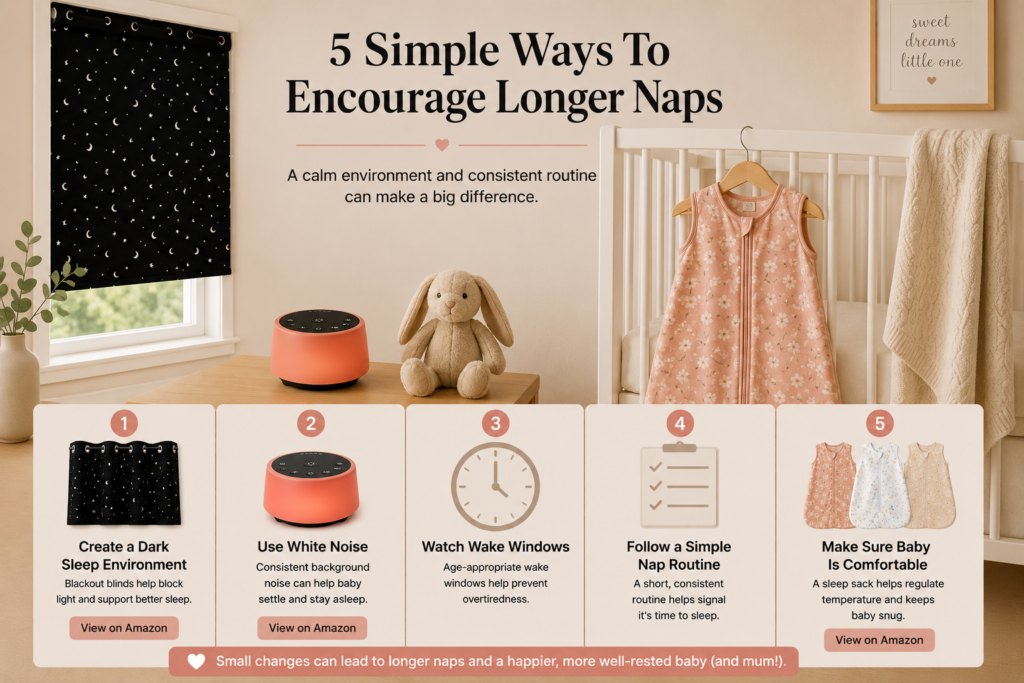
If you’re dealing with short naps, you’re probably willing to try just about anything. While there’s no magic solution, these are a few things that genuinely helped us create a more sleep-friendly nap environment.
Create A Dark Sleep Environment
Once my baby became more aware of the world, every little thing seemed to be a distraction. Making the room darker helped create a calmer space for naps. I’ll be honest, I always said I wouldn’t get one, but I was very wrong, It is an essential in my household now,
My recommendation: Portable Blackout Blind
Use White Noise
I was sceptical at first, but white noise quickly became part of our nap routine. It helped block out household noise and created a consistent sleep environment. The red light was an added bonus too.
My recommendation: White Noise Machine
Watch Wake Windows
One of the biggest things I learned was that timing matters. If my baby stayed awake for too long, naps were often shorter and settling became much harder. Using a Sleep Tracker really helped me.
My recommendation: Baby Sleep Tracker
Follow A Simple Nap Routine
Our routine was never complicated. A quick nappy change, sleep sack, white noise and cuddles were often enough to signal that it was time to sleep. You’ve just got to find what works best for you.
Make Sure Baby Is Comfortable
Sometimes it’s the simple things that make a difference. A comfortable sleep space and the right sleep sack can help babies settle more easily.
My recommendation: Lightweight Sleep Sack
Remember This
If your baby only naps for 30 minutes, you’re not doing anything wrong.
I know how easy it is to watch the monitor, compare your baby to others and wonder why everyone else seems to have a baby who naps for hours. I’ve been there too.
The truth is that short naps are often completely normal, especially during the first year. While it’s helpful to understand baby nap lengths by age, every baby develops at their own pace.
If there’s one thing I’d want you to take away from this article, it’s that a short nap doesn’t automatically mean you’ve got a sleep problem to fix. Sometimes babies simply need a little more time to develop those longer, more predictable naps.
And if today has been one of those days where you’ve spent more time settling your baby than actually sitting down yourself, make yourself a cup of tea and give yourself some credit. You’re doing a great job.
More Baby Sleep Guides
Wondering whether your baby’s wake windows could be affecting their naps? I’ve put together a simple guide to baby wake windows by age, including a handy chart, age-by-age wake windows and a few of our favourite sleep essentials and wake window activities that really helped us.
This article is for informational purposes only and is not intended as medical advice. If you have concerns about your baby’s sleep, feeding or development, please speak to your health visitor, GP or healthcare professional.